
Your schedule is chock full. Invoices are flying out the door. Money is steadily flowing in.
But your bank account is still so sad.
How? Why? What the F*?
Because too much is going out.
So You Want More Money
When the bank account is sad, our instinct is to look at marketing. More work = more money. Adding more money to the money place should solve the money problem. Right?
Not always. Not usually, even.
Because your money place is a damn sieve. It has holes in it.
Is that a tired metaphor? Yep. Is it accurate? Also yep.
So why does your money place have holes? Most likely it’s because you and your team are reacting to every moment of your day and it’s super inefficient. Here are a few common culprits:
Wasted technician time (ahem, supply house runs!)
Slow-to-send and poorly written estimates
Sloppy communication causing dropped balls
And so, so much more. Here’s my line:
Marketing gets you revenue. Operations decides how much of it you actually keep.
BOOM. Mic drop.
WTF is Revenue Retention?
For every dollar that comes in the door, how much survives the trip to your bank account?
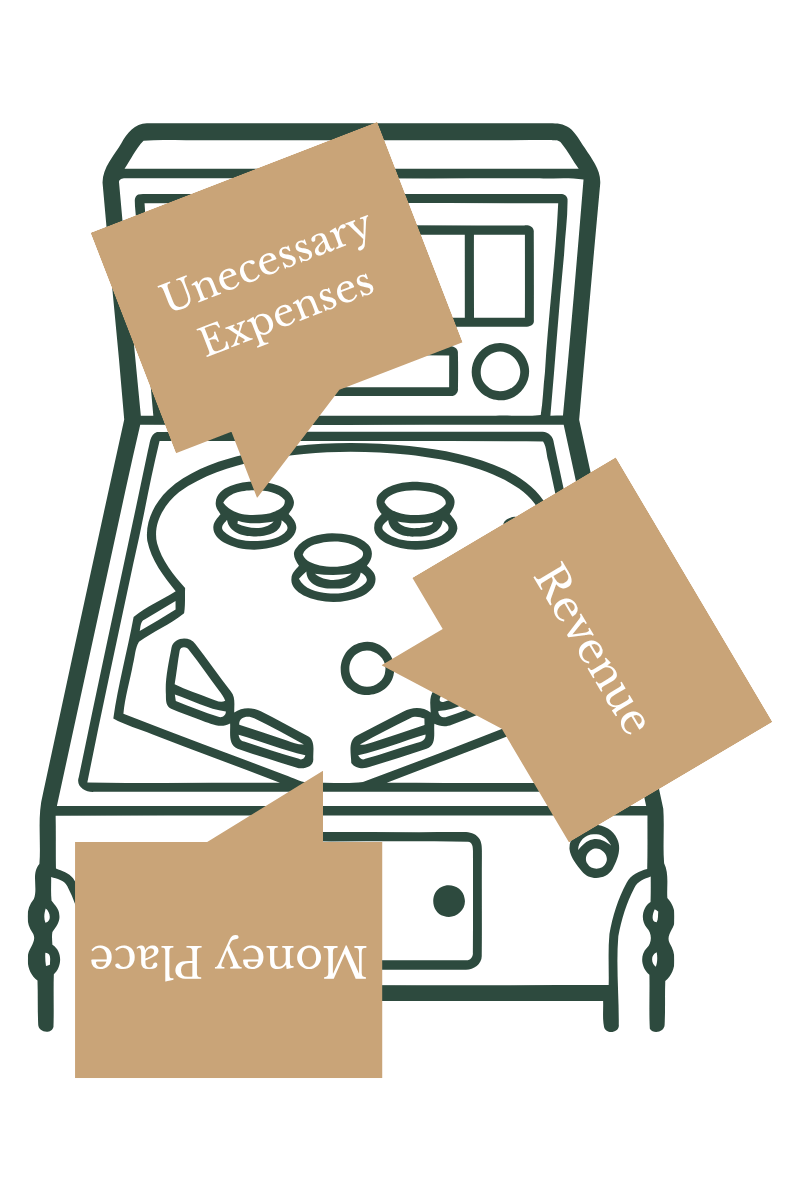
Think of your revenue as a pinball. Every time the pinball tries to go into the money place, a flapper hits it and pings it up into the mechanics. But instead of adding to your score it’s taking a few pennies off that dollar.
Instead of launching that ball up into the mechanics of your business and letting it fall neatly into the revenue hole, it hits a bumper called “Oops, Don’t Have all the Parts.”
Then it hit’s a bumper called, “Oops, didn’t charge for shop supplies.”
Then it lights up the thing called, “The next job was across town instead of across the street.”
And by the time the ball goes into the hole, it’s worth a fraction of what it used to be.
Anyway, revenue retention means getting the ball to the money place without hitting the bumpers. So, the opposite of how you play pinball. But hopefully my metaphor makes sense anyway.
Where the Money Actually Goes
You have departments. I don’t care if you are doing all the jobs in all the departments - you have departments. Field operations, sales, accounting, marketing, hiring, blah blah blah.
Every one of those departments is a potential bumper in your pinball machine and each one loses money a little differently.
It’s usually most obvious in field operations because technician time is most directly tied to revenue. You do two jobs in a day and each is worth $500 vs. five jobs in a day each worth $500.
Yeah, you don’t have to be an operations or accounting genius to figure out which is the better option.
The two job guy was probably doing supply runs, waiting for approvals, looking for tools on his nasty truck, etc. etc.
Here’s some deeply un-fun math:
One 40-minute supply-house run each day loses roughly 167 hours over a year. At $150 an hour, that’s a $25,000 hole in your retained revenue. Ew.
And before you tell me that a supply house run doesn’t take 40 minutes - I’m going to need you to stop lying to yourself. It’s not just the time in the truck and at the counter. And yapping. And the bathroom break. It’s also stopping and starting and getting into the flow of work again.
It’s obvious in the field, but that doesn’t mean this isn’t happening in every part of your business. Here’s some of how it shows up in other places:
Sales
Estimates don’t get followed up on.
You aren’t doing any marketing to previous clients.
You aren’t showing your customers upgrade options.
The size of the hole: You paid the acquisition cost, but aren’t getting the full revenue.
Accounting
Slow invoicing.
No late invoice follow-up.
Books not regularly reconciled.
The size of the hole: Money is slower to go into the money place and billing errors don’t get caught in time.
Lead Handling
Don’t always answer the phone or slow to respond.
Not qualifying leads before going out.
The size of the hole: You’re literally just leaving money on table, bruh. Did you pay for those leads? Yeesh. Even worse. Also over time this will trash your reputation.
Hiring
Employee onboarding is just, like, a ride along.
You hire anyone who will pass a background check.
The size of the hole: You won’t find out their work is trash until it’s too late. You are paying full wages for someone to run their own business in your truck.
Software
Duplicate or rarely used tools.
Under-utilizing
The size of the hole: Subscription fees for days.
While not an exhaustive list, hopefully you are starting to get the idea. It’s like death by a thousand cuts. Or, bumpers? I think I’m done with the pinball metaphor.
An Example of My Own
The best example I can pull from my own memory is our estimate process. Not follow up or anything like that, but the conversation and options the plumber had with the customer during the diagnostic.
So, before the process was defined it was just up to the plumber what they recommended. So the old-school guys would repair - with duct tape and rubber bands if they had to.
The young bucks would just replace, replace, replace. (Often because no one taught them to repair, honestly.)
And then there were the guys who loved the new shiny, the tech, and everyone else hated that they sold the sh*t that came with apps.
But which one is those is right? Well … it depends.
We really needed to decide what we - the owners of the company and people who defined the brand and values - wanted our customer experience to be.
So we built a standard. It was basically a decision tree for how many options to offer. All the standard advice is "give three options.” Which, cool. Yep. I get it.
But here’s the real life of it:
Some people can’t afford an upgrade.
Some people love bougie stuff and always want to upgrade.
Some sh*t shouldn’t be fixed because it’s a damn liability.
Some things are worth repairing and replacing it is wasteful.
When possible, we didn’t make the decision for the customer. We let them decide what they want for their home and what they can afford. But also we didn’t want to do the strict “you must give three quotes” because sometimes that’s just a dumb path.
Anyway, I’m off topic.
The whole point is that we wanted a consistent experience that relied on good customer service rather than sales or plumber preference. We trained our staff on how to decide what options and conversations to have with the customers.
All while holding our values at the center of the conversation.
Spot It. Size It. Stop It.
Truth is, I didn’t think “Spot it. Size it. Stop it.” but it’s damn good phrase so we’re going to use it.
You probably already have something in your mind that you are thinking is a hole.
So let’s start there. You are already a third of the way done.
1. Spot it
Where are we depending on memory, vibes, or personal preference?
Look for the things that just happen a certain way because that’s how Judy-from-accounting likes to do it. Look, it’s fine if you like the way Judy does it. But what happens if Judy gets hit by a bus? (RIP, Judy but what steps did you take to follow up on overdue invoices again?)
Don’t let something in your company break because someone is out sick. Or dead. Jeez this got dark.
2. Size it
How big’s the hole? Some juice isn’t worth the squeeze. Don’t spend $500 or a week of training fixing a $10 problem.
This isn’t rocket science, just use reasoning and judgement to figure out where you can make the biggest differences with the smallest lift. And try to do the simplest version that won’t break.
3. Stop it
Here’s the hard part. It’s the worst when you have to ask people to change behavior because we are TERRRRRRIBLE at that. As in, humans. Humans are terrible at changing our behavior.
So keep it simple. Checklists, templates, flow charts.
Write that sh*t down. I beg you.
Keep the Money, Honey
I really want you to keep more money in your money place. I want you to have lots of resources so you can do things that feel good and live at ease. I don’t want things to be hard for you.
So, let’s do like … a little bit of a hard thing. But on purpose so that the hard doesn’t happen to us on accident while we are broke.
You got this. But if you don’t, book a 20 minute free session. I’ll hold your hand, look you in the eye, and help you get it.